Dhokla
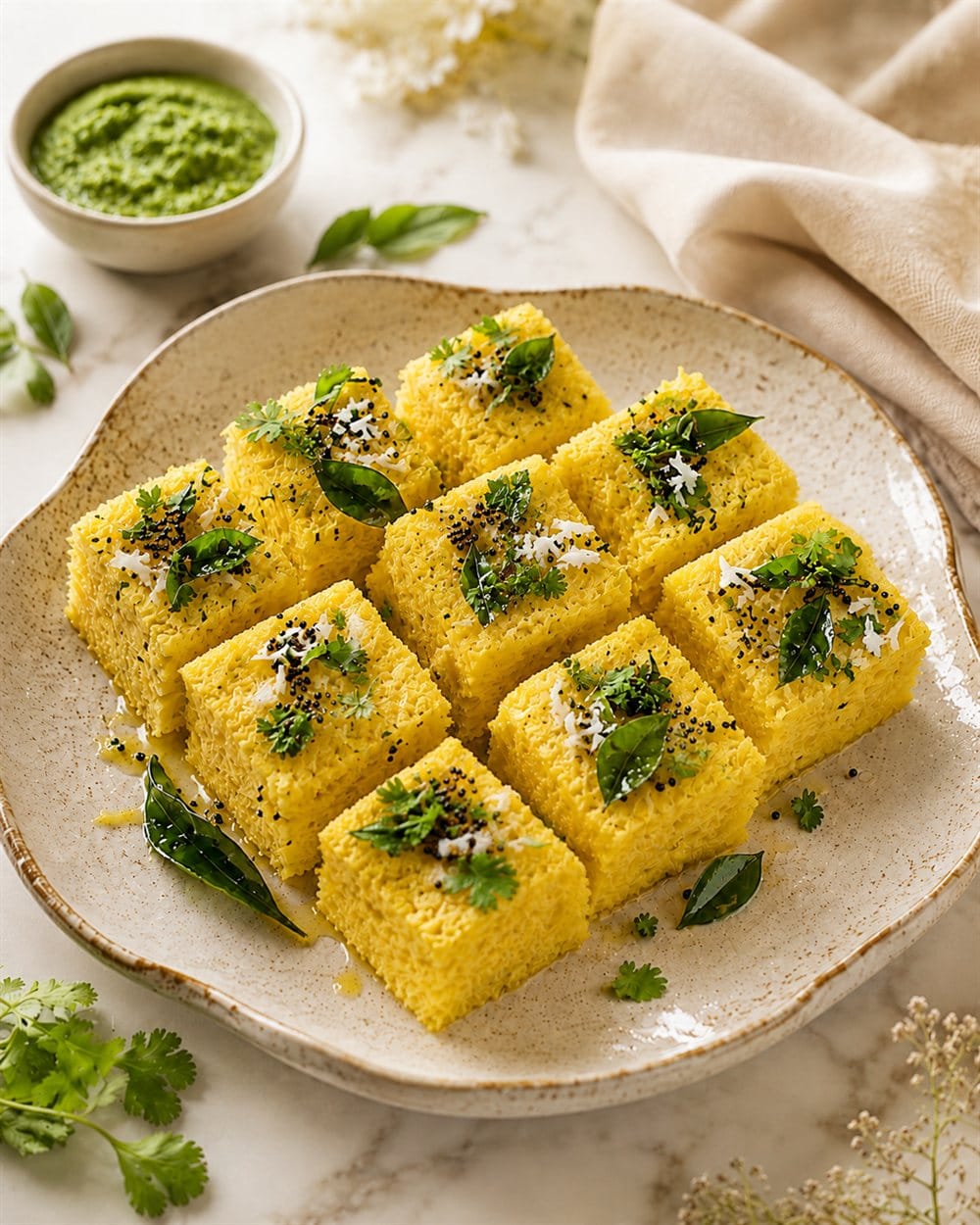
Steamed chickpea-flour cake, soft and slightly sour, finished with a sizzling mustard-seed tempering.
I learned to make dhokla from my friend Priya's mother — a Gujarati woman who had married into a non-Gujarati family in the 70s and made it her quiet personal mission to teach everyone in the surrounding neighborhood at least one proper Gujarati dish. By the time I left for college, I could make dhokla, undhiyu, and a passable thepla. Of the three, dhokla is the one I still actually make on a regular basis. It's a small but real piece of someone else's family I get to carry with me.
Gujarati cuisine is often described as "sweet" by people who haven't really sat down with it, and that description misses the entire point. The sweetness — when it shows up — is always balanced against sharp acidity from yogurt or lemon, warmth from chile and ginger, and the deep, almost mineral savory of mustard seeds and curry leaves bloomed in hot oil. Dhokla is the dish that demonstrates this most cleanly: a soft, slightly sour, gently sweet square that gets brought into focus by the hot, tangy tempering you pour over it at the very end.
The traditional fermented version takes the better part of a day, batter resting overnight, the whole thing eventually rewarded with a deeply complex tang. This Eno-leavened shortcut version gets you on the table in under an hour and tastes — honestly — nearly identical. Priya's mother would call this cheating. She would absolutely also have eaten it without complaint and asked for the recipe.
The texture should be like a sponge. Airy. Just barely springy. Ready to soak up the tempered oil. Get that right and you've got a proper plate of dhokla. Get it wrong — overcooked, underleavened, dry — and you've got a sad chickpea-flour brick that nobody wants. Both have happened in my kitchen. The good one is much, much more common now.
Cooking tips
Eno (or a baking-soda-and-citric-acid stand-in) gives the dhokla its signature lift — it has to go in right before steaming.
Letting the batter rest before adding the leavener helps the flavors come together without sacrificing the rise.
Steaming over a gentle, steady heat — not a rolling boil — produces a more evenly cooked, tender dhokla.
A hot tempering of mustard seeds, sesame, curry leaves, and chiles poured over the warm dhokla is what takes it from "nice" to "non-negotiable."
Ingredients
For the batter:
- 1 1/2 cups besan (chickpea flour)
- 2 tablespoons fine semolina (rava)
- 1 cup plain yogurt
- 3/4 cup water (more as needed)
- 1 tablespoon neutral oil
- 1 teaspoon grated ginger
- 1 green chile, minced
- 1/2 teaspoon turmeric
- 1 teaspoon sugar
- 1 teaspoon kosher salt
- 1 teaspoon Eno fruit salt (or 3/4 teaspoon baking soda + 1/2 teaspoon citric acid)
- Juice of 1/2 lemon
For the tempering:
- 2 tablespoons neutral oil
- 1 teaspoon mustard seeds
- 1 teaspoon sesame seeds
- 15 fresh curry leaves
- 2 green chiles, slit
- 1/2 cup water
- 1 tablespoon sugar
- Pinch of salt
To finish:
- Cilantro and grated fresh coconut
Method
1. Make the batter
Whisk the besan, semolina, yogurt, and water into a smooth batter — thick but pourable, like pancake batter. Stir in the oil, ginger, chile, turmeric, sugar, and salt. Rest 15 minutes.
2. Set up the steamer
Add a few inches of water to a wide pot. Set a rack inside, place a greased 8-inch square pan on top. Bring the water to a gentle boil.
3. Activate, pour, steam
Right before steaming, whisk in the Eno (or baking soda mix) and lemon juice — just until foamy. Pour immediately into the pan. Cover. Steam over medium-high heat 18 to 20 minutes, until a knife comes out clean. Cool 5 minutes.
4. Make the tempering
Heat the oil in a small pan. Add the mustard seeds; when they pop, add the sesame, curry leaves, and chiles. After 30 seconds, carefully pour in the water with sugar and salt — it sputters. Bring to a quick boil.
5. Soak and serve
Pour the tempering evenly over the warm dhokla. Let it soak in. Cut into squares, top with cilantro and coconut. Serve with green chutney.
A note: Don't let the batter sit around after you add the Eno — it loses its lift in minutes. Have your steamer hot and ready before you reach for the leavener. I learned this the hard way, twice, both times producing a dense slab that I tried to convince a friend was "the traditional way." She didn't buy it.